
Seurat and the Sea
The Courtauld Gallery, Strand – Until 17th May 2026
I have never thought of Art and Science as being opposite ends of the spectrum. The Artist and Scientist are both endless experimenters and pursuers of progress, where continual failure can eventually funnel its way toward success for the inquisitive, the determined and the patient.
Where art often imagines, science proves and disproves itself, but one would not imagine art to be ahead of the game. And yet when Einstein proposed light consisted of particles in 1905, Georges Seurat, whilst along the Sienne and the northern coast of France had already discovered the photon nearly 20 years earlier – and he did so merely with his brush. Furthermore, European art embarked on the scientific pursuits of light, dimensions and motion via Impressionism, Cubism and Futurism – thus defining the first part of the 20th century.
Sadly, due to his untimely passing, Seurat (1859 – 1891) never saw the latter two movements, dying at the young age of only 31. What he gave to us in his short time was not only 45 paintings (a number of which were celebrated during his short life), with half comprising of seascapes, but also a new style of seeing (life around us), and quite possibly a connection with science. In just two large rooms upon the Strand, The Courtauld has, for the first time curated a collection of the Pointillist’s Channel coastal works – stretching from Grand Camp to Gravelines, navigated in his time by the construction of new railway lines which linked places we now take for granted.
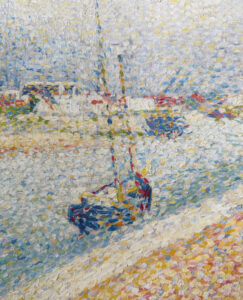
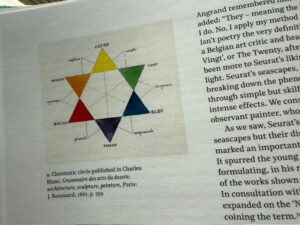
Some of these works are simply exquisite. The pipette-like precision of each meticulous point, which at a distance creates flickering waves of light and serenity, together with the careful balance of hue must have taken many experimental failures before finally perfecting the technique. And perfected to the point that he had the confidence to produce at larger scales. Impressionism epitomised en plein air, and neo-Impressionism was no exception with many preliminary studies produced, some delicately in conte, before his completed painted studio versions. But whereas Monet wanted to capture the light at a particular moment in time, Seurat developed a more analytical method, drawing upon the colour wheel of Charles Blanc.
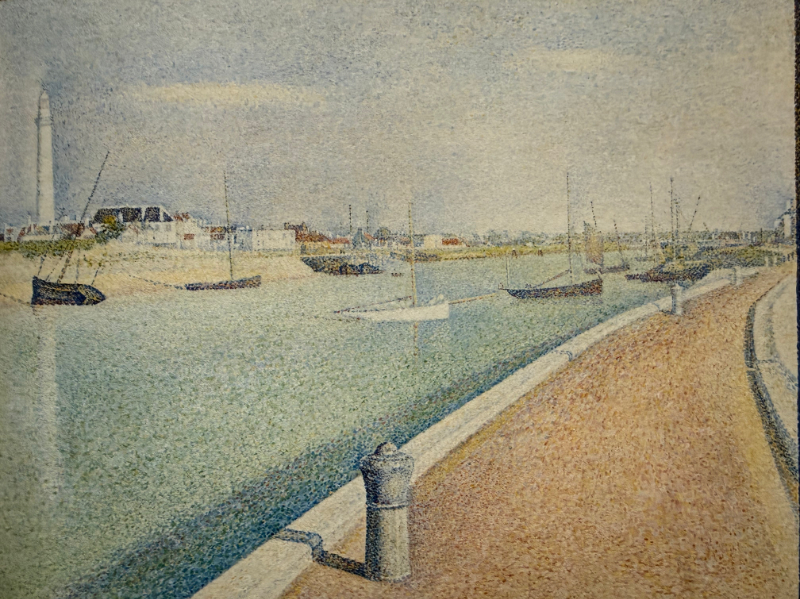
The Channel of Gravelines (1890) depicts a peaceful setting from the canal side, everything is formed from delicately mottled light and pastel hues. Light creates both form and structure. Points sensitively change size – it’s acutely subtle but calculated. The scene is practically ephemeral or maybe hyper real – I can not decide. A cast iron mooring post and its shadow have received a similar amount of attention as a person’s face would have – and as the boats too. And this may be a key point – there isn’t a bias, with just one exception in this show, it is devoid of human interaction, and even then there is an uneasy surrealism to it. Natural light does not prejudice, everything is equally cared for – as Seurat’s brush points demonstrate. Every point has a purpose, every square inch is carefully rendered.
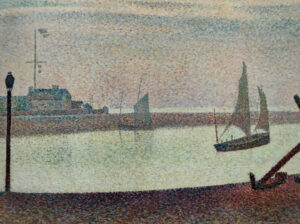
Seurat’s quantum pursuit resulted in the scaling down from the earlier and heavier Van Gogh style strokes, to moving ever closer (but without the aid of scientific instruments) to the essence of light. And the art of this technique must have been painstaking at times and diametrically opposed to the pleasure experienced in the viewing of the scenes he often captured. I wondered how many points were actually in this exhibition. Impossible to count. Indeed, 3D laser scan models are quantified by the number of points, and here was Seurat in the 1880s and still in his twenties inventing the point cloud – now an industrial term in laser scanning. Furthermore, on the coast of northern France he was explaining to us that light was made of particles – thus fusing art and science. He would split two colours apart, juxtaposing them side-by-side to create a visual effect known as optical fusion, rather than mixing the colours together. This shimmering effect sometimes gave the illusion of movement and certain works such as Le Bec du Hoc (Grandcamp, 1889) exemplifies this skill.
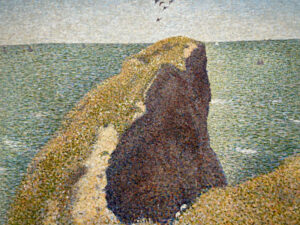
A grassy rock formation rises whale-like from the baseline of the composition as if to capture the dark forms above it. They are birds but we could believe for a moment that they are fish. The head tip punctures the sea horizon, splitting the channel. The sensitive distribution of light and colour creates a delicate texture and yet the terra firma is hefty, solid and convincing. There is a kind of peaceful suspense to this. One could almost meditate in front of it.
There are no edges in his works, everything consists of particles separated by space. The paintings draw the eye in to inspect the minute detail. Tiny points inside not quite so tiny points (like electrons inside the atom) create a shimmering chemical effect. Sometimes there is an under layer of colour which Seurat punctiliously overlays with points of light. Nothing makes sense close up and he would have had to have worked at this distance whilst understanding the optical effect, at say 6 or 10 feet away.
What perhaps distinguishes Seurat’s light from Rembrandt’s, Turner’s or Monet’s is the implied science. The distance between each point is as important as the point itself. Density, resolution, weightings – all modern terms in digital image making but this was in the 1880s.
Space has become a form of structure. And as delicate as many of these works appear (some of the veil-like imagery could almost blow away in a breeze), the boats, the port buildings, the fish market and coastal hills all have a structural rigidity without containing any actual engineered lines. There is a real finesse to his optical trickery, but we do not feel fooled – just delighted.
Seurat also provides a narrative for an industrialising northern France. The sign to Southampton, lighthouses and cast iron. Then we wonder how he was able to traverse along the coast with such ease. Where Paris drank and danced, here life would have sauntered at a much less hedonistic pace with the quieter daily necessities of the fisheries and shipping trade.
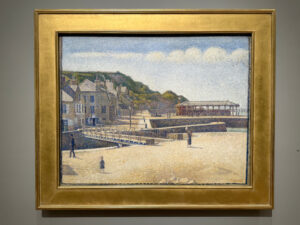
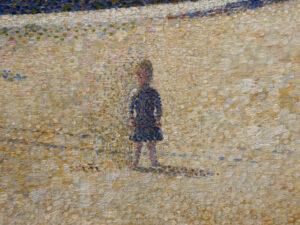
In his most intriguing work Pont-en-Basin (1889), we are presented with the rare sight of figures, and yet despite being depicted from speckled points they have a curious form of character about them. Who is the little girl? Does she belong to one of the adults? The bridge and harbour walls zigzag, luring us towards the dwellings and beyond, such is his careful balance of light and colour. And a few of the locals by the fish market may have even moved whilst my eyes were strolling about.
We are also treated to the palette of dusk without ever seeing the sun set – just its effects. And perhaps one of the best aspects is that our own senses and experiences of coastal walks and sea air are summoned in front of these perspectives so we add our own nostalgic emotions to them. Something I cannot say of the emotionless and over-saturated landscapes of Hockney. These are of the north coast of France yet they could also be of Cornwall, Sussex, or Pembrokeshire. They are timeless and yet they take us back in time and then we realise we are inspired to plan another trip such is their attraction.
This show is also well worthy of a visit, not just because it’s the first time these works have been assembled together, but because it is a celebration of light and the sea – and not to mention the other adjacent rooms of impressive Impressionism. I am also mindful of Ed Isaac’s current RBSA show and these two exhibitions make an interesting comparison.
As a collective they provide an hour or two of contemplation. It may sound contrived but one can almost hear the sea. In fact, I know I did.
These paintings were never as well known as his Parisian riverside works but they should have been, and perhaps they will be more so now due to the commendable efforts of the Courtauld. Why had no one ever done this before we wonder?! The light has finally shone.
Seurat and the Sea
The Courtauld Gallery, Strand.
– Article written by Graham Everitt